Ernest Goh
WORKS:
THE FUNFAIR OF FORGOTTEN FUTURES
Play is often one of the earliest casualties of crisis. Yet, as history has shown us, it also persists in the darkest times. George Eisen, in Children and Play in the Holocaust, describes how children, even in the midst of unimaginable horror, continued to play—not necessarily for joy, but as a means of making sense of their world. If play can be a mirror, reflecting both trauma and resilience, what then are the games of a climate-challenged generation?
Much like the games of children in wartime, who imitated the violence and absurdity of their surroundings, the games in this installation mimic the absurdity of our current ecological reality. These games are not just entertainment; they are acts of processing, of confronting the forces that shape our lives.
But play is not only a reflection—it is preparation. As ethologist Marc Bekoff suggests after observing wolf pups at play – play trains us for the unexpected. It builds adaptability, fosters resilience, and nurtures new ways of thinking.
In a world that demands urgent action, The Funfair of Forgotten Futures asks whether we can harness play to rehearse the transformations we so desperately need. Can a funfair be a training ground for survival? Can games equip us for radical change?
In this participatory art installation, the audience is more than a spectator; they are players in a system, engaging firsthand with the challenges we face. Yet, as in all games, there remains the potential for joy, for strategy, for a way forward. Through the language of play, The Funfair of Forgotten Futures invites us to navigate the contradictions of crisis and possibility, despair and imagination.
What does it mean to play and rehearse in an era of ecological collapse? What does fun look like in a world unraveling?

BLEACHED BONES
Bleached Bones is a visual catalogue of photographic prints by artist and photographer Ernest Goh. In this exhibition curated by Shireen Marican, bleached corals capture timeless, poignant last words of the departed. Bleaching is a phenomenon when corals turn completely white after algae in their tissues are expelled when their waters are too warm — nature’s lasting reminder that climatic changes continue to influence ecological systems. Ernest’s explorations across the shores of Nikoi Island in Indonesia led to a discovery of the unique formations of these bleached corals. In these, he finds a visual parallel to the alphabet system which he draws upon to contemplate lessons of life and living from death poems and last words. More about the exhibition at Blueprint Art Advisory and read the curatorial essay here.


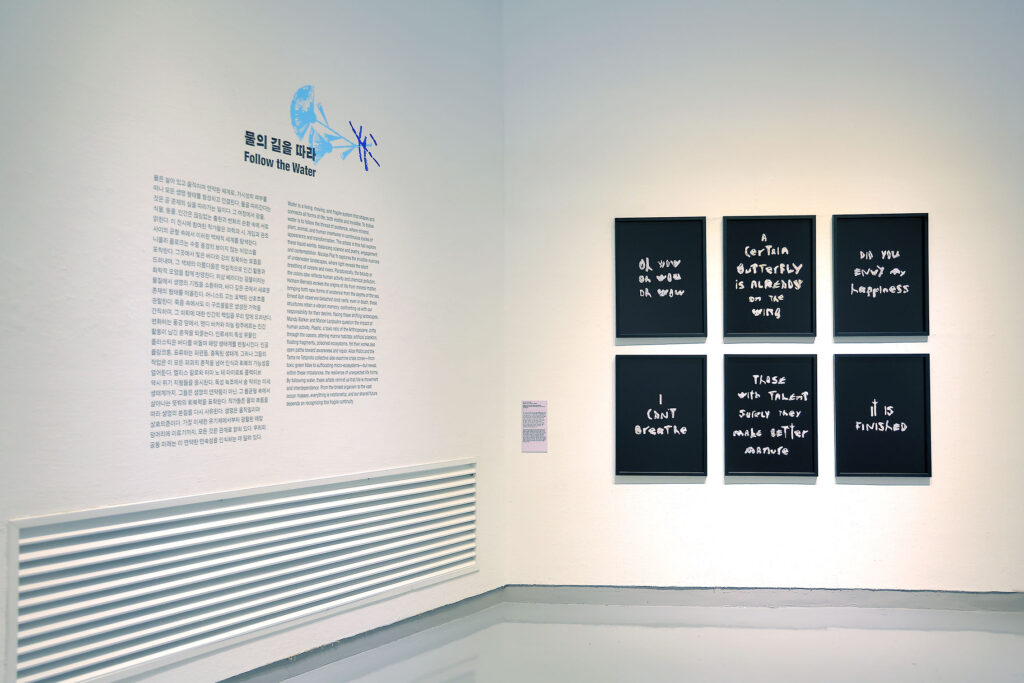
Bleached Bones, Daegu Photo Biennale 2025, South Korea.
PLASTIGLOMORATES
Plastiglomerates are marine debris, usually plastic, that has been fused with natural materials such as ocean rocks, sand and wood. These plastic-rocks are now considered by social scientists and geologists to be a potential marker of the Anthropocene, a proposed geological timescale that dates from the commencement of significant human impact on Earth’s geology and ecosystems.
In Jane Bennett’s Vibrant Matter where she discusses recognising the active roles of human and nonhuman forces in events. The artist wanted to explore the kind of ‘rock-matter’ that could be produced by the active participation of his own, and as an exact opposition to the ‘naturally-made’.

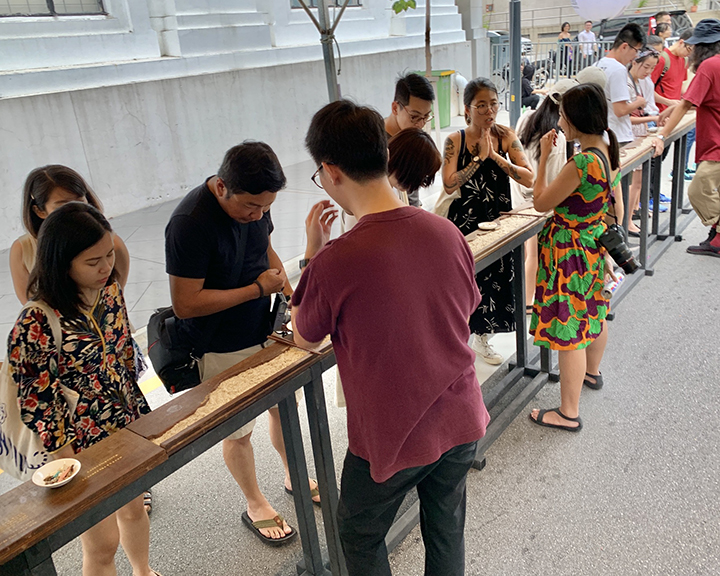
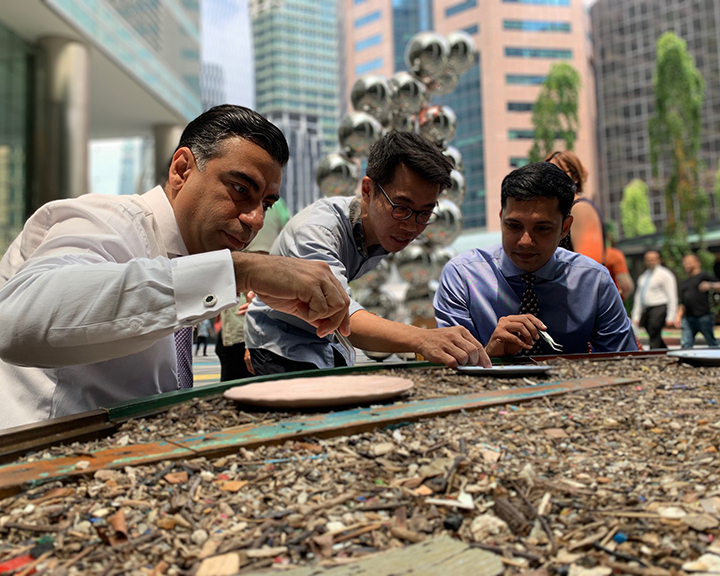
A 10-metre long dinning table surface that presents shore debris collected from Punggol beach Singapore. Participants are invited to remove micro plastic – ocean plastic fragments 1 – 5mm in size. The work prompts participants to develop a deeper understanding of the plastic pollution crisis, its complexities and contradictions. Can we truly think of ourselves as detached from nature, at a time where microplastics have found their way into the air, our food and even our bodies?



Creatures of the Meek
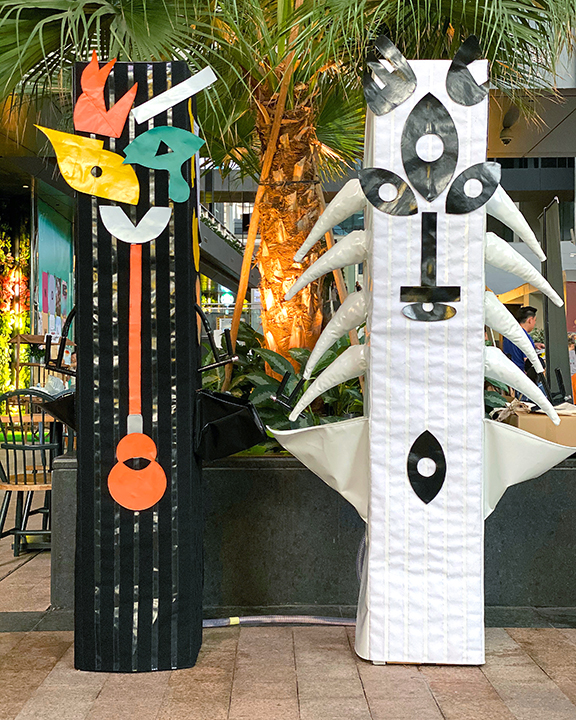
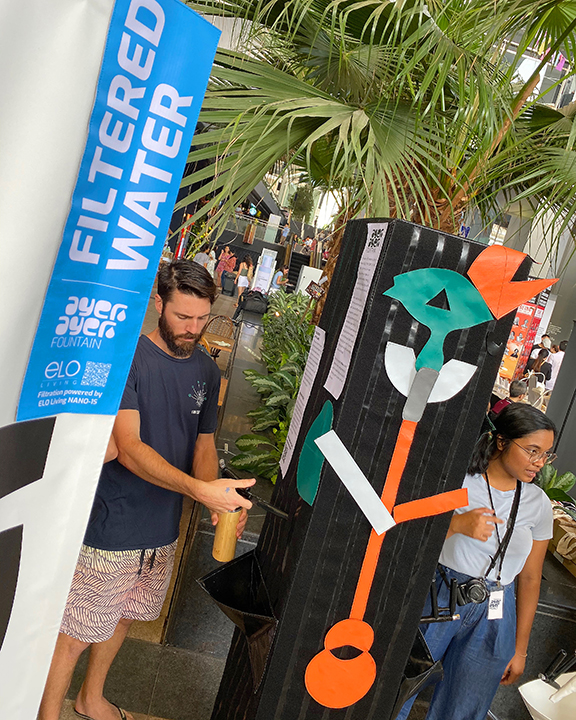
The meek will inherit the earth, transforming into creatures forged from a culture of ignorance. Born from the remnants of the devastation left behind by man, they survive in an environment stripped of its resources. They are the aggressors and the victims, the monsters and the protectors, takers, and the givers. ‘CREATURES OF THE MEEK’, is a water refill station created by the artist by crossing participatory public art and a social utility such as a public drinking water fountain.
Plastic waste has reached tremendous amounts around the world. Even with efficient waste management systems and recycling initiatives, we will soon be unable to cope with the hundreds of tons generated every day globally. We can, however, stop contributing to plastic waste by reducing our use of single-use plastics. Refuse a plastic bottle of water, opting instead to refill a reusable bottle at a public drinking water fountain.






PROJECTS:
Lead artist Ayer Ayer – an ecologically-engaged initiative that reaches out to communities through visual and participatory artworks to foster environmental protection and awareness. Ayer Ayer’s focus on ocean plastic in the regional waterways of South-East Asia has led to the creation of public art, digital gamification and research projects.

Artistic-director Ubah Rumah – an artist residency and research outpost located on Nikoi island, Indonesia. The residency programme offers artists and researchers an opportunity to explore and investigate cultural and climate issues faced by islanders of the Riau archipelago. The programme partners Nikoi – an ethically developed island destination focused on bringing unique experiences that minimises negative impact in the short term and has a long term positive impact on the local community and environment.

The Animal Book is the result of the artist’s fascination with the natural world that began as a boy at his grandmother’s rural kampung in Siglap, Singapore, where he waded in longkangs looking for fish and jumped into bushes searching for fighting spiders.

REACH:
Instagram: @theanimalbookco
Email: ernest@ayerayer.com
Ernest Goh is an artist and photographer whose practice examines the relationships between ecology, place and the more-than-human world. Moving between photography, participatory art and socially engaged practice, his work explores how images and collective experiences can deepen our understanding of the environments we inhabit.
He is also co-artistic director of Ubah Rumah, an artist residency and research outpost on Nikoi Island, Indonesia, supporting Southeast Asian artists and researchers working across art, ecology and place. His works have been commissioned by and presented at the Lee Kong Chian Natural History Museum, Singapore, collected by the Multimedia Art Museum, Moscow, and are held in public and private collections.
Prior to his art practice, Goh worked as a photojournalist, documenting social and environmental conditions across Southeast Asia. His reportage includes coverage of the Burmese refugee crisis along the Thai–Burmese border and the aftermath of the 2004 Indian Ocean tsunami in Aceh, Indonesia. His photographic work has appeared in TIME Magazine Asia, Newsweek, Der Spiegel, Monocle, and the Smithsonian.
Goh has received the National Environment Agency EcoFriend Award (2024), Icon de Martell Cordon Bleu Discernment Award (2012), the Sony World Photography Award (2013), the Incentivising Innovation Fund from the Institute of Contemporary Arts London and Nesta UK’s Cultural Leadership Programme (2009), and the Philips Design Award (1999). He holds an MA ICCE from Goldsmiths, University of London.